
What hardware shoppers need from your product pages
We reviewed 16 hardware buying questions to find what shoppers need before choosing a product. Use the findings to improve your store's product pages.
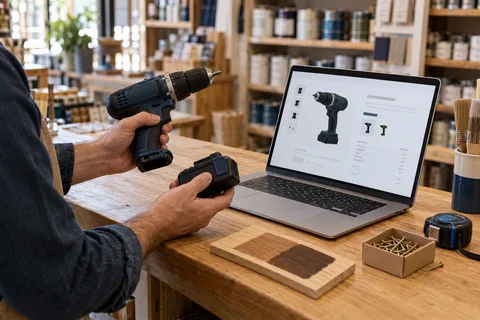
Someone lands on your drill page. They can see the price and the model number. But they still don't know whether their battery fits, whether a charger comes in the box, or whether this is the right tool for the work they have planned.
That uncertainty is familiar if you run a hardware or paint store. You answer it at the counter every day. Your product pages need to carry more of those answers when you're helping someone who hasn't walked through the door.
To work out which answers deserve space, we reviewed 16 public Reddit product-choice questions across drills, exterior paint, deck stain and fasteners. We also read X discussion, a merchant forum, current platform documentation and recent shopping news. The questions gave us a useful way to turn broad advice about better product content into a specific page brief.
Our clearest finding: 13 of the 16 selected questions combined two or more kinds of buying information. Price was one concern. So were the intended job, compatible parts and the work involved after purchase.
What we counted in the shopper questions
We selected four questions in each product category and coded only the original post. Comments didn't add to the totals. Each question could receive several themes, so the rows below overlap.
| Information the original question raised | Posts in our 16-question sample |
|---|---|
| Fit for a project, material, exposure or required dimension | 15 |
| Reliability, durability or future maintenance | 7 |
| Color, sheen or visible finish | 6 |
| Compatibility, matching parts or product substitution | 5 |
| Budget, deals or whether a higher price is worth it | 5 |
| Preparation, application or required extra components | 5 |
These are Lookelo's counts from a small, deliberately selected sample, not estimates of all hardware shoppers. The posts came from several countries and were published between January 1 and October 5, 2026. They don't establish a growing trend or measure what New England customers ask most often.
You can inspect every question, date and coding decision in the 16-row source dataset. Our interpretation is that a useful page needs to help someone connect the product to their situation. A longer description alone doesn't establish that connection.
A drill buyer needs to understand the whole purchase
One buyer wanted a drill for furniture assembly and wall fixings, around a stated budget, with at least one battery included. Another was weighing a discounted tool against the commitment to a battery platform. Both questions make more sense once you consider what the buyer will need alongside the drill.
For a cordless tool, put the exact battery system beside the product name. Make the included components easy to spot. If you're selling a bare tool, explain that in ordinary language before someone adds it to their cart. Show the manufacturer's stated applications and link the exact model's specifications.
An illustrative content block might read: "Tool only. Battery and charger sold separately. Check the compatible battery models below before ordering." Add the actual compatible models after checking the manufacturer's documentation; a voltage number on its own isn't a complete compatibility statement.
That block is a proposed writing example. We haven't tested whether it changes sales, and it isn't a specification for a particular drill.
Paint and stain buyers need the conditions behind the claim
Six of our eight paint and deck-stain questions raised color or finish. Four explicitly raised durability or maintenance. A New Jersey deck owner, for example, asked about preparation, a dark-walnut finish and later recoating, while describing both sun and snow exposure.
For that person, "long-lasting outdoor protection" leaves several decisions open. A useful page connects the exact product to suitable surfaces, the finish they'll see and the preparation required by the manufacturer.
Keep those answers distinct. A color image helps someone judge appearance. A preparation section helps them understand the work. A technical data sheet provides the product's stated limits and application conditions. Your store can make that information easier to find without promising that a particular coating will solve every surface problem.
If you sell several finishes in one product family, label the chosen sheen, tint or opacity clearly. Show samples in context where you have genuine photographs, and identify the surface used. Don't present a screen swatch as a guarantee of how a customer's weathered wood will look.
For a retailer in New England, build the page around the conditions your staff actually discuss with customers. The sample includes other climates; it doesn't justify copying a Florida recommendation onto a Massachusetts product page.
Get help answering your customers' product questions.
Fastener questions reveal where specifications need explanation
Three of the four fastener questions raised compatibility or substitution. One person had bought a replacement bracket pack but still lacked the screws for the device itself. Another asked which screws and wall plugs to pair for a shelf installation.
Those questions expose a writing problem you can check on your own site: does the specification tell a beginner what they're choosing?
Show diameter and length with their units. Identify the head and drive type, then explain any manufacturer-stated material or application limits. Distinguish a replacement part's dimensions from a claim that it fits a specific assembly.
Where the choice depends on load or a particular fixing system, point to the exact manufacturer's selection instructions. A retailer's description should make those requirements visible. An anonymous forum recommendation isn't enough evidence for an application claim.
AI shopping makes clear product information more useful
On October 5, TechCrunch covered TikTok's shopping assistant and checkout launch.
A separate ReFiBuy study announcement published October 6 described 40 U.S. participants completing 224 shopping tasks across ChatGPT and Google AI Mode. Its headline product-card finding used a narrower set of 104 ChatGPT tasks in watches, electronics and bags. The study measured choices rather than completed purchases, and card position wasn't randomized. It doesn't tell us how much an independent hardware store will sell through AI.
The practical connection to our questions is an inference: if a shopper is comparing products through another interface, accurate product information has to travel with the item. You still need to make that information understandable on your own page.
Shopify's current product-discovery documentation describes Catalog listings with titles, descriptions, options, images, prices and availability. It also explains mapping for stores with product data in custom fields. Shopify qualifies eligibility and says direct checkout is still rolling out, so availability needs to be checked for the actual store and channel.
A merchant in the Shopify Community asked how to confirm visibility from a customer's point of view. In a Shopify launch discussion on X, a reply asked about shopping context and its effect on sales. We kept those industry questions and announcements in separate source notes. They aren't extra hardware shoppers in our sample.
Our existing guide to formatting content for Google and AI covers the broader page structure. Start by checking whether the page answers the questions someone needs resolved before choosing the item.
Start with ten product pages and check the answers
You don't need to rewrite your entire catalog to try this. Choose ten products that generate questions at the counter or through your website. Use your own questions to decide which fields matter; our counts are a starting point for that discussion.
| Page field to review | What you should be able to answer |
|---|---|
| Intended use and limits | What job or material is this exact product suitable for? What should the buyer check first? |
| Compatibility | Which existing parts or systems does it work with, according to the manufacturer? |
| Package contents | What's included, and what else is required? |
| Preparation and maintenance | What work does the exact product require before use or later? |
| Product options | Which size, color, sheen or finish is selected? |
| Fulfillment | Is that variant available at the relevant store, and how can the customer receive it? |
Fulfillment is an additional operational check we recommend. We didn't code it as a theme or include it in the research totals.
- Collect the questions your staff hear about those ten products. Keep the customer's wording where you can record it without personal details.
- Check each answer against the exact SKU's current manufacturer documentation and your store's actual offer.
- Put the short answer near the relevant choice or purchase control. Link detailed instructions where the buyer needs more information.
- Compare the visible page with the product data you distribute through your active sales channels, then assign someone to maintain both.
Record the same measures before and after: product-page visits, add-to-cart events and orders, plus product questions or returns where you can classify them. Keep the observation periods comparable and note changes to pricing, stock or advertising. A quieter support inbox can be useful, but it doesn't prove that copy alone caused a sales change.
This is ongoing ecommerce website management: keeping the customer's answer accurate as the product, stock or store offer changes.
How to use the findings responsibly
We searched public questions on October 13, 2026, selected four readable examples per category and applied six information themes. One researcher coded the original posts. Each positive code has a paraphrased evidence note; search-selected, category-balanced questions don't provide a representative demand estimate.
The research method and codebook explain the queries, exclusions and retrieval limits. The public dataset distinguishes complete indexed post text from direct page reads. We didn't measure missing information on retailer websites or test a change in AI visibility. The ten-product review above is a proposed next step.
Use the questions to inspect your own pages and ask your staff where customers still get stuck. Then write the answer that helps someone choose the right product from your store.