What Shoppers Ask Before They Buy Wall Anchors
We read 25 posts from DIYers stuck hanging shelves, mirrors and TVs in October. See what they asked and how your store's site can answer before they buy.
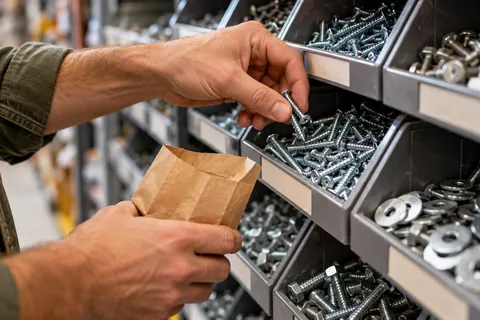
"Will this hold?" Your hardware counter answers it every day, usually while someone holds up a plastic anchor and describes a wall they can't see inside.
So we counted how often people ask it online. Between October 3 and November 2, 2026 we found 25 separate Reddit posts from people trying to hang or mount something on a wall who asked which anchor to use, whether it would hold, what size to buy, or why the one they used had failed.
Their questions show what your fastener aisle's pages should say. Here's what they asked, and how your site can answer it before they make a second trip.
What did shoppers ask about wall anchors this month?
Most wanted to know what to buy. 20 of the 25 posts asked which anchor to use, whether a specific one would hold, or what size to get. The other 5 asked why an anchor had failed and how to go on.
| What the original post asked or said | Posts (of 25) |
|---|---|
| An anchor or screw had already pulled out, stripped, crumpled or wouldn't go in | 12 |
| Which anchor, plug or toggle to use | 10 |
| No stud where the item needed to go | 10 |
| Whether a specific anchor or setup would hold | 9 |
| What screw or plug size, length or diameter to buy | 9 |
| Gave the item's weight | 4 |
| Mentioned the hardware that came with the item | 4 |
These are Lookelo's counts from a small sample of public Reddit posts. A post can count in several rows. They don't measure how often your customers ask, and we didn't check whether the advice posters got was right. Every post and coding decision is in the question dataset, and the methodology lists the searches and limits.
Look at the top row. Almost half the posters were asking after something had already gone wrong. One curtain rod's anchors ripped out of the drywall. A bookcase bracket's screws stopped short and stripped on three of four holes. A hose reel kept pulling its plugs out of brick. Each of those is a second purchase, and a customer who'd rather have bought the right thing the first time.
What were they hanging, and on what?
Shelves came up most (6 posts), then bathroom fixtures like towel bars, shower bars and a glass shower door (5), curtains (4), mirrors (3), TV mounts (2) and a wall cabinet (1). The rest were outdoor lights, a bike mount, a hose reel and a shop display.
| Wall the poster described | Posts (of 25) |
|---|---|
| Drywall or plasterboard | 12 |
| Not stated or unknown | 5 |
| Brick, block or mortar | 3 |
| Panelling, beadboard or tile over another wall | 3 |
| Metal studs | 1 |
| Acrylic shower enclosure | 1 |
That spread is the whole problem. "Wall anchor" covers products made for very different walls, and five posters didn't know what their wall was made of. One poster's anchors went in fine on one part of a wall and crumpled a foot away at the end of a half wall. Another was hanging a mirror cabinet on panelling glued to brick, where the supplied screws barely made it through the panel.
Why does "will this hold?" keep coming up?
Because the honest answer depends on three things the package rarely puts together: the wall, the weight, and how the load pulls. Shoppers usually know only one of them.
Weight is the clearest gap. Only 4 of the 25 posters said what their item weighed: a 28 lb mirror, a 10 to 12 lb shelf rail, an 8 to 10 kg mirror cabinet and a 100 lb TV. The TV poster had bought toggles because the package said they were rated well past 100 lb, then saw advice online recommending a bigger size and stalled.
Package numbers are part of the confusion. TOGGLER's technical bulletin for its SNAPTOGGLE anchors says its load values are guides, that the wall's age and condition must be considered, and that "industry standards recommend 1/4 of ultimate test load." A shopper who reads the biggest number on the box as the safe working load is reading it wrong, and most product pages never say so.
And the hardware in the box often isn't enough. Four posters mentioned the anchors or screws that came with the item, and none of them trusted that hardware. In two cases it had already failed, one set of screws was too short for the wall, and one poster doubted the kit's plastic anchors would hold a glass shower door. One wrote that the anchors packed with their curtain rods "were clearly not up to the task."
See how Lookelo builds product pages that answer these questions so your customers leave with the right anchor the first time.
What should your anchor product pages say?
Each anchor page should answer the questions in that first table, near the top, in plain words. Here's a checklist for the anchors and toggles you stock:
- List the walls it's for, and not for. Drywall thickness range, plaster, hollow block, solid brick, tile over backer board, metal studs. If it won't work in solid masonry or a hollow-core door, say so.
- Give the working load the maker publishes, and say what it means. If the maker lists ultimate and recommended loads, show both. If it only lists one number, quote it as the maker's and point to their data sheet.
- Name the screw it takes. Diameter, length range and thread, so the shopper who bought plugs and needs screws (or the reverse) can match them. Two posters in our sample asked exactly this.
- Give the drill bit size. Several posts in our sample described trouble at the hole: anchors that wouldn't go in, holes that blew out, or holes that grew too big for the anchor.
- Say what it's good for. "Curtain rods, towel bars, small shelves" is far easier to act on than "medium duty."
- Say when to skip it. Heavy or moving loads like a pull-down TV mount, a grab bar or a loaded closet shelf are usually better fixed to a stud, blocking or a backer board, and the mount maker's instructions come first. Shoppers trust a store that tells them when not to buy something.
- Show price and whether it's in stock today. Add Product structured data so Google can show those details. Google's merchant listing documentation explains how price and availability can appear in search results.
If you've already worked through our checklist for what hardware shoppers need from your product pages, add these lines to the fastener pages you fixed.
Should you add a "which anchor do I need?" guide?
Yes, if fasteners are a real part of your floor. A short guide that matches the job to the anchors you actually carry answers the question 10 of our 25 posters asked outright, and it links straight to products a customer can reserve or order.
Keep it as a table: the wall down the side (drywall, plaster, brick, tile), the job across the top (picture or curtain rod, towel bar, shelf, mirror or cabinet), and the product you stock in each cell with a one-line reason. Add a row for "I don't know what my wall is" with how to tell. Link each cell to the product page, and link the guide from every anchor, toggle and hanging-hardware page. If you sell online, put it beside your online product catalog so the right screws can go in the same order.
Two cautions. Write the guide from your staff's real advice and the makers' data sheets, and don't promise any anchor will hold a given weight in every wall. And for anything heavy or safety-critical, like a TV mount over a fireplace or a grab bar, point the customer to the mount maker's instructions and to finding framing, not to a bigger plastic anchor.
Will Google and AI tools use this information?
They can only use what's written down. When a shopper asks ChatGPT or Google "what anchor do I need to hang a 28 lb mirror on drywall," the answer gets pieced together from pages that state the wall, the weight and the product clearly. A page that names the wall thickness, the screw size and the drill bit is far easier to quote than one that says "heavy-duty holding power."
That's the same idea behind making your website easy for AI tools to understand: plain statements, one question per heading, and facts that match what's on the shelf. We did the same thing for paint last week with what your customers ask about primer.
How we counted
On November 2, 2026 we ran 156 past-month Reddit searches for fastener phrases like "what anchor," "drywall anchor," "toggle bolt" and "what screws" across 12 home improvement and woodworking communities. We read the titles of 134 posts with a fastener word in them, opened the 44 that looked like a shopper choosing or using a fastener, and kept original posts about hanging or mounting something on a wall. That left 25 posts. We dropped 19 after reading (structural and deck fasteners, screw removal, hole repair and two crossposts), and the reasons are recorded.
Six posts came from a UK community, most posters aren't in New England, and searching with fastener words likely missed people who described the problem without them. Treat the counts as a picture of what people ask, not a measure of your market. The summary file has every count, and we've published no usernames or comment threads.